Completed together with Estefania Maldonado.
Our project is about understanding and archiving the history of the octagon in order to project a new future. We are not interested in re-inventing the shape but about understanding where the octagon has been, and speculating on where it might be going. This is often the case with any ordinary shape (be it a circle, a square, a triangle), but the octagon shape drives today’s focus because it is one of the few defining shapes that exist within our given context, Slocum Hall. Through our video we will take you on a deep scan of the octagon, to visualize its past, present, and future in four different acts. The final projection within each act is meant to reference the octagon’s entire history within the categories.
ACT 1 GEOMETRY: The octagon is a plain figure with eight straight sides and angles.
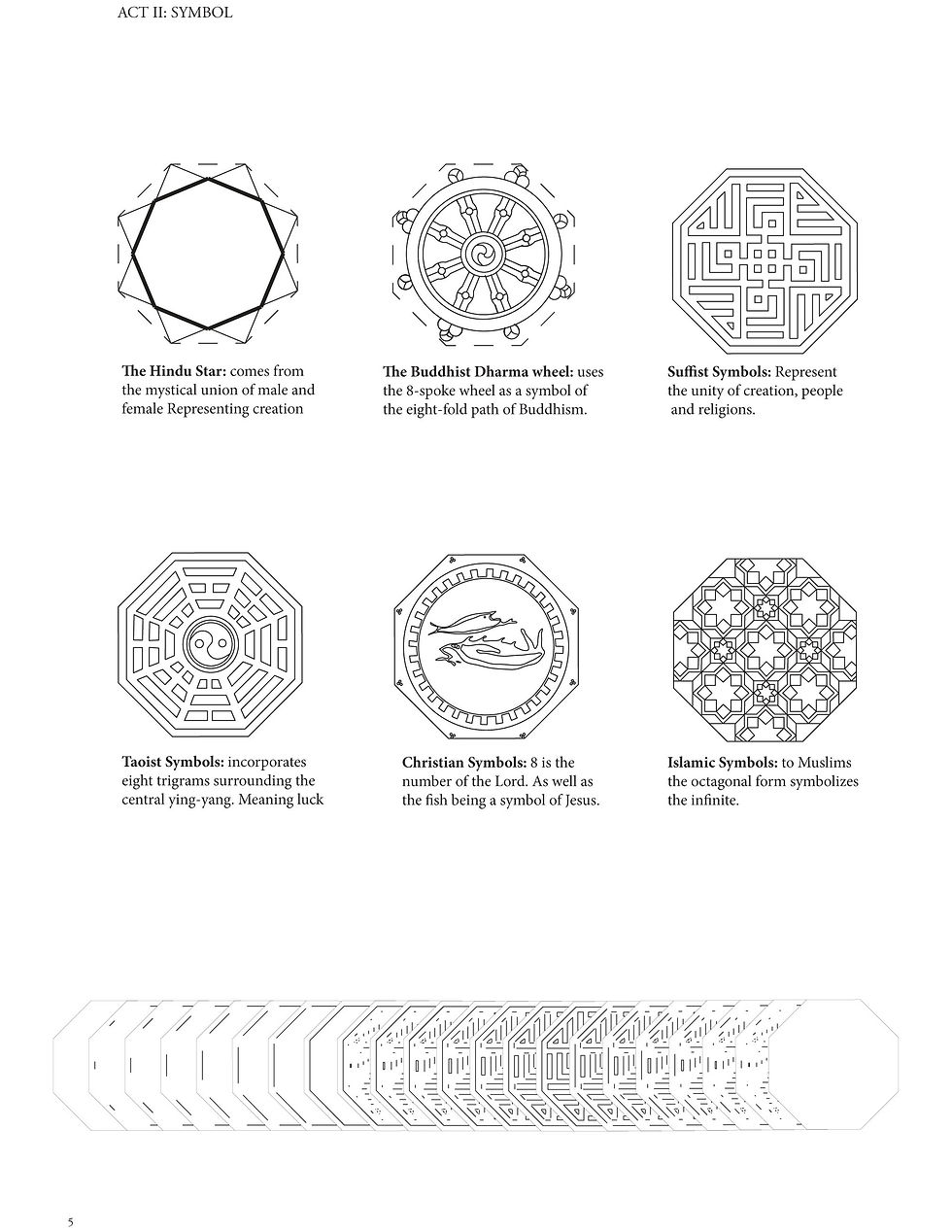
ACT 2 SYMBOL: The octagon has a historical background of symbolic meaning for various religions.
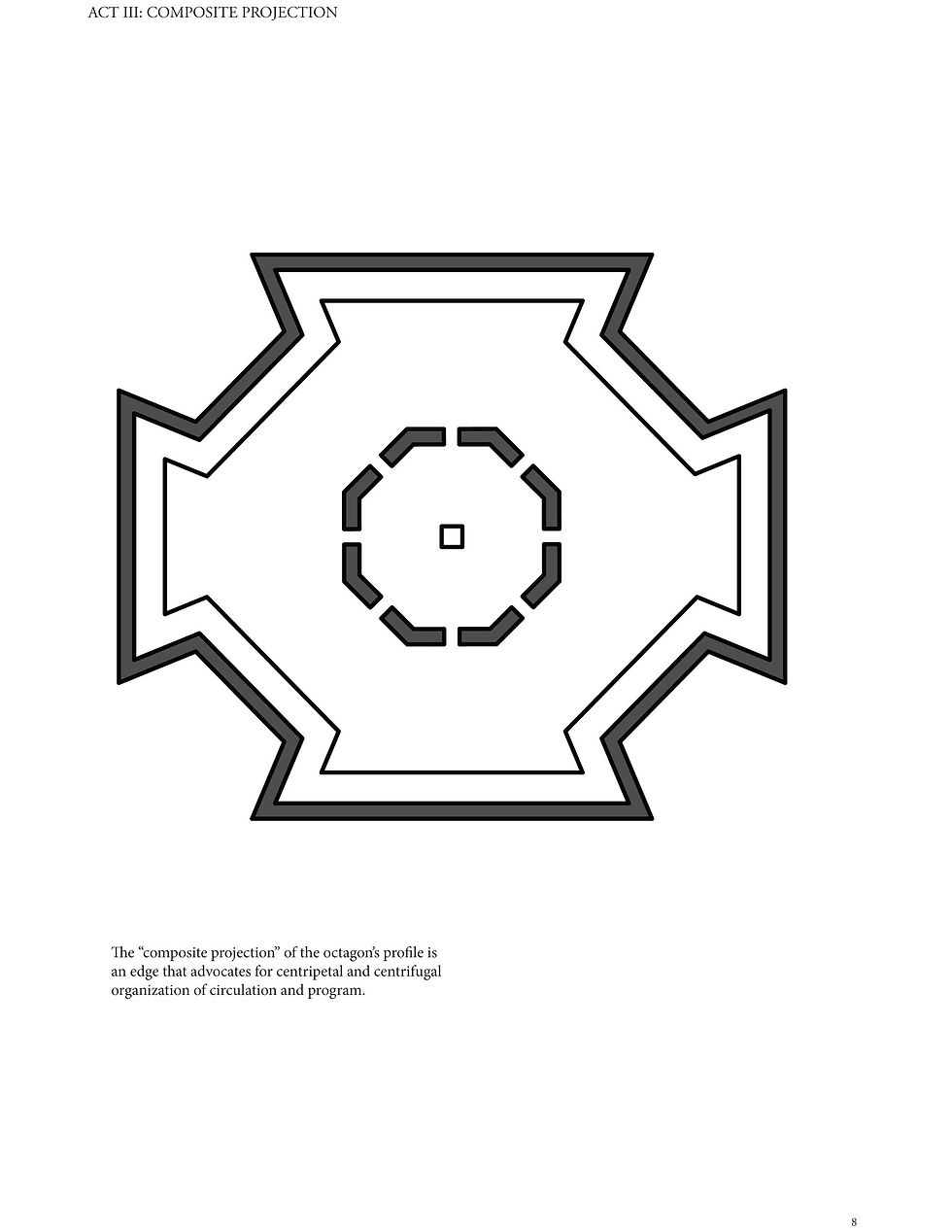
ACT 3 CHARACTER: It is about the profile of the shape, the edge and its thickness. Sure, other attributes exist but these are meant to intensify the interior organizational relationship to the exterior treatment of the edge.
ACT 4 COMPLEXITY: Here we can elaborate on a complexity of “cultural meaning/value” and “geometric legibility.” The octagon is not always legible, but resonates in most of these examples by shifting the way we look at the octagon - whether it be through perspective or experience.
As a result, through our projection we are able to reveal and x-ray of the historical and cultural evolution of the octagon. It is not about the perfect octagon or the type of shape used, but in our case it has to do with understanding of where the octagon has been, and speculating on where it might be going. As Walter Nestch says, the octagon is a universal image of good architecture that is geometrically ordered where form must follow function. We believe the octagon is too loaded a shape to allow to rest in the main public space of Slocum Hall because it is underused for its purpose . Its form doesn’t reflect these buildings functions nor does it have a deep meaning for being there. When “looking closely” we realize that beneath the simplest of geometry, there lies a more profound story.
A Brief History of the Octagon
Fall 2014